

Back2Back beat downs in LA

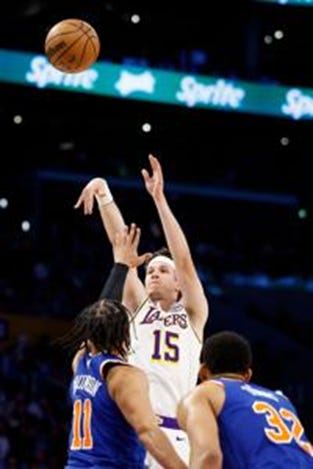
The New York Knicks entered their matchup against the Los Angeles Lakers hoping to bounce back and maintain momentum in the Eastern Conference race. Instead, the game highlighted several issues that have surfaced recently: inconsistent offense, rushed decision-making, and a lack of dependable bench scoring.
Early in the game, the Knicks struggled to establish rhythm. They opened the first quarter 1-for-8 from three-point range, while the Lakers found their range earlier, hitting 4-of-10. The shooting disparity wasn’t enormous, but the Knicks’ offensive flow never truly developed.
At the start of the second quarter, the Lakers seized momentum with a 7-0 run, pushing their lead to 11 points with 8:01 remaining in the period. During a particularly difficult stretch, the Knicks went 7 minutes and 2 seconds without a made field goal. The scoreboard read 52-47, representing a missed opportunity for New York to regain control.
Offensively, the Lakers were led by Luka Dončić, who had 14 points at halftime, and Austin Reaves, who added 17. For the Knicks, Jalen Brunson and OG Anunoby each finished the half with 11 points.
The Lakers continued their push in the third quarter. Maintaining their strong record when leading after three quarters, Los Angeles opened the period with a 12-2 run and later added another 9-0 burst. Even without LeBron James on the floor for stretches, the Lakers’ offensive efficiency remained high. When Dončić and Reaves shared the court, the team has been 18-2 with a +13.31 net efficiency, illustrating how effective their partnership has become.
Despite the adversity, the Knicks showed resilience in the fourth quarter. New York responded with a 12-2 run, cutting the deficit to 89-86 with just over eight minutes remaining. They later extended that push into a 16-4 run over nearly six minutes, bringing the game within reach.
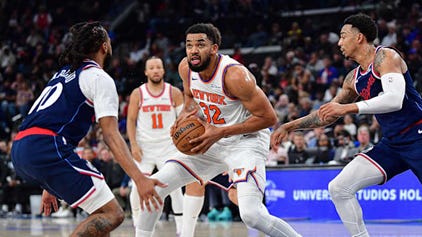
The standout performance for New York came from Karl-Anthony Towns. Towns finished with 25 points and 16 rebounds, including 15 defensive rebounds, recording his 45th double-double of the season—currently the most in the NBA following the absence of Domantas Sabonis.
Still, the Knicks ultimately fell short. The Lakers only made seven more three-pointers, but New York’s inability to maintain offensive rhythm proved decisive.
Another troubling performance came from Mikal Bridges, who finished 0-for-10 from the field and failed to score. When the starting lineup struggles offensively, performances like that make it difficult for the Knicks to stay competitive.
Bench consistency remains another major issue. The Knicks often relied on Deuce McBride to deliver timely scoring, and his production has historically helped keep games close. However, without consistent support from other bench players, the team’s offensive balance suffers.
New addition Jordan Clarkson provided a spark when inserted in the third quarter, helping cut the deficit to just a few points. His ability to generate offense quickly may be exactly what the Knicks need, but consistency from the bench unit remains critical.
The Knicks’ loss to the Los Angeles Clippers the Following night showed similar patterns, despite a more aggressive start. New York opened the game attacking offensively and appeared far more consistent early on.
Brunson set the tone immediately. By the end of the first quarter, he had 13 points and was directly responsible for 15 of the Knicks’ first 19 points, either through scoring or assists. However, as the game progressed, the Clippers’ efficiency and pressure gradually widened the gap.
One of the most damaging trends came from missed opportunities. On three separate possessions, the Knicks grabbed two offensive rebounds but settled for three-point attempts on all three follow-ups, failing to capitalize on second-chance opportunities.
Meanwhile, the Clippers capitalized on mistakes. They scored 24 points off Knicks turnovers, turning defensive stops into easy offense.
Towns again delivered a strong performance, finishing with 35 points, 12 rebounds (10 defensive), seven assists, and a block. He also shot 3-of-4 from three-point range, an impressive 75% from deep. Despite that efficiency, he still finished with a negative plus-minus, underscoring how the team struggled collectively while he was on the floor.
Brunson added 28 points, shooting 52.2% from the field while recording eight assists. Over the past three games, he has averaged 12 assists per game, showing his growing role as the offensive engine.
Another notable stat line came from Josh Hart, who recorded 12 points and 13 rebounds while shooting 71% from the field. Yet even Hart finished with a –13 plus-minus, highlighting a deeper team issue.
Defensive Concerns and Rotation Questions
One of the more concerning developments has been the Knicks’ one-on-one defensive matchups. Opposing teams are targeting specific players, exploiting mismatches and forcing the Knicks to scramble defensively.
Hart remains valuable due to his rebounding, transition offense, and improving three-point shooting (around 39%). However, his heavy workload may be contributing to defensive lapses. Reducing his minutes slightly while maintaining him in the starting rotation could preserve his impact.
Additionally, the Knicks must improve their offensive rebounding outside of Hart. Extra possessions can help stabilize the offense during cold shooting stretches.
Bench production also needs to improve. Clarkson’s scoring ability offers a spark, while defensive specialists—such as José Alvarado—represent the type of defensive intensity the Knicks could benefit from alongside offensive punch.
Ideally, the Knicks would find a balance: Clarkson’s offense combined with Alvarado-level defensive pressure.
The Path Forward
The Knicks remain one of the league’s better defensive teams, but recent results show that defense alone isn’t enough when offensive rhythm disappears.
Fatigue may also be playing a role. The team’s success earlier in the season has placed a target on their backs, and opponents are bringing playoff-level intensity against them.
The formula moving forward appears clear:
Improve bench scoring consistency
Reduce turnovers and rushed possessions
Maintain offensive rebounding
Adjust rotations to balance minutes and energy
In conclusion, with just 16 games remaining in the regular season, the margin for error is rapidly shrinking for the Knicks. Head coach Mike Brown’s challenge is not only to refine the team’s strategy but to ensure that every player remains fully aligned with the collective mission.
As Duce McBride emphasized earlier in the season during his interview with Cowboy Bob, “We all have to be locked in as a team to win.” If the Knicks can reestablish their offensive rhythm while continuing to uphold their defensive identity, they possess the talent and structure necessary to remain a legitimate contender. However, the urgency of the moment demands immediate focus, consistency, and accountability from every member of the roster as the team pushes toward the postseason.